Hiring an excavator should be simple: choose a machine, dig, go home. In practice, the people who overpay almost always make one of three mistakes. They hire the wrong size, they compare day rates and forget about transport and diesel, or they book “by the hour” without reading the minimum-hours clause. This guide fixes all three, and gives you the checklist we wish every customer had before they phoned us.
Quick answer: On published South African plant hire rate cards (2024 to 2026), a mini excavator costs roughly R160 an hour or about R1,450 a day, and a 20 to 30-ton excavator about R4,200 to R4,900 a day, excluding VAT and diesel. Most suppliers bill a minimum of 8.5 to 9 hours a day, and getting a 20-ton machine to site can cost as much as a full day’s hire. The right size comes down to three things: how deep you dig, how much material you move and how much space you have.
- Which excavator size do you need?
- Excavator hire rates in South Africa
- The real cost: a worked example
- Wet hire vs dry hire
- Excavator, TLB or skid steer?
- Attachments worth knowing
- Licences, safety and the law
- Your pre-hire checklist
- 7 expensive mistakes
- Excavator hire in Piet Retief and Mkhondo
- Frequently asked questions
Which excavator size do you need?
Excavators are sold and hired by operating weight, in tons. The weight tells you three useful things at once: how deep the machine digs, how fast it moves material and how much space and transport it needs. Bigger is not better. A 30-ton machine in a suburban backyard is slower, dearer and more destructive than a mini excavator that fits through the gate.
| Class | Operating weight | Dig depth | Best for | Watch out for |
|---|---|---|---|---|
| Mini (1.5–3 t) | About 2,260 kg for a Cat 302 CR | About 2.5 m (302 CR: 2,570 mm) | Garden and plumbing trenches, small foundations, landscaping, tight yards | Small bucket, slow on bulk earthworks |
| Midi (5–10 t) | 5,000–10,000 kg | Deeper than a mini, varies by model | House foundations, septic tanks, longer pipe trenches, small dams | Needs a lowbed or large trailer, more access room |
| Standard (20–22 t) | About 20,400 kg for a Cat 320 GC | About 6.6 m (320 GC: 6,630 mm) | Bulk earthworks, farm dams, roads, loading tippers, stump removal, pipelines | Arrives on a lowbed, heavy on soft ground and paving |
| Large (30 t +) | 30,000 kg and up | Deeper, with longer reach | Mass excavation, rock with a breaker, quarries, large civil jobs | Higher transport cost, overkill for small jobs |
Rule of thumb: hire for your biggest regular task, not your biggest possible one. If one corner of the job needs a deeper reach, it is often cheaper to bring in a bigger machine for a day than to pay for it all week.
Four questions that choose the size for you
- How deep? A 1 m service trench and a 4 m dam wall are different machines.
- How much material, and where does it go? If it has to be loaded onto trucks, you want a machine that can reach over a tipper’s side and keep up with it.
- What is the narrowest access point? Measure gates, gaps between buildings and overhead clearances. A mini excavator with its tracks retracted can be just over a metre wide.
- What is the ground like? Wet clay, paving, septic tanks and slopes all affect the choice of tracks, weight and protection mats.
Still torn between the two most popular sizes? Our 20-ton vs 30-ton excavator comparison goes deeper into bucket size, fuel use and output, and the mini excavator hire guide covers small jobs and tight sites.
Excavator hire rates in South Africa
There is no national price list, and every quote depends on the machine, the hire period, the site and whether an operator and diesel are included. To give you a realistic starting point, we compared published rate cards from South African plant hire companies. These are reference figures, not a Bendet price list.
| Machine | Per hour | Per day (8.5–9 h) | Notes |
|---|---|---|---|
| Mini excavator (1.5–3 t) | About R160 | About R1,440–R1,600 | Cheapest to move; often fits on a trailer |
| Midi excavator (5–10 t) | Quoted per job | Roughly R2,000–R3,000 (estimate) | Fewer published rates, so treat this as a guide only |
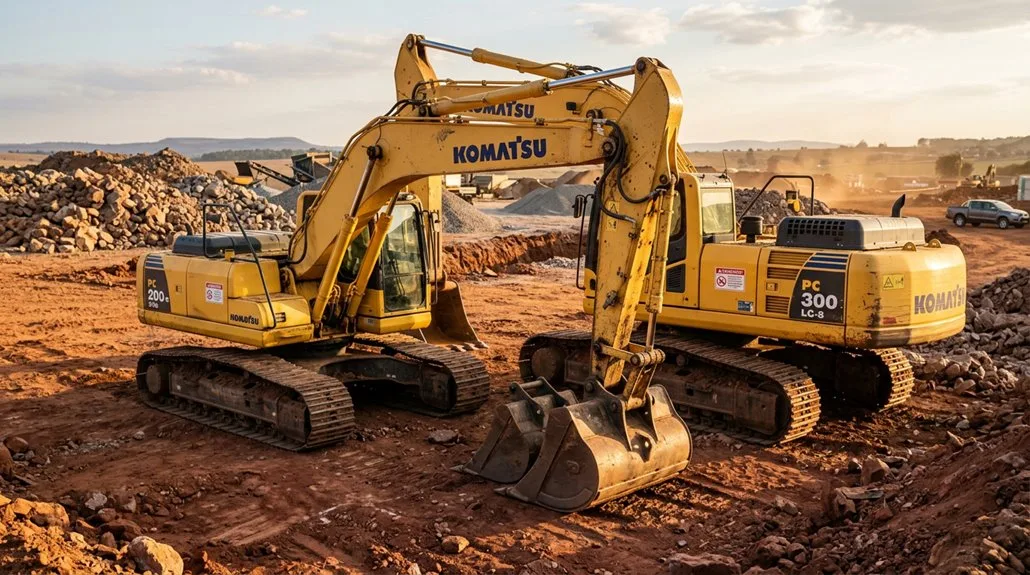
| 20–21 t excavator | About R485–R495 | About R4,200–R4,400 | The workhorse size for earthworks and farm jobs |
| 30 t excavator | About R540 | About R4,800–R4,900 | For big volumes, rock and deep digs |
Rates exclude VAT and diesel and are taken from 2024–2026 dry-hire rate cards; some include an operator, some do not. For more detail by machine size, see our breakdown of excavator hire rates per day.
How suppliers actually bill you
- Minimum hours. A “per hour” rate rarely means one hour. Many rate cards charge a minimum of 8.5 or 9 hours per day, whatever the hour meter says.
- Time out vs time worked. Some suppliers charge from the moment the machine leaves their yard, not when it starts digging.
- Weekly and monthly rates. Longer hires usually bring the daily rate down, which is why it pays to plan the whole job in one booking.
- Standing time and rain days. Ask what you pay if the machine is on site but cannot work because of weather or your own delays.
Did you know? In South Africa, “dry rate” does not always mean “no operator”. Plenty of suppliers include an operator in their dry rate and only exclude diesel, while others mean the bare machine. Always ask exactly what the rate includes. Our guide to wet rate vs dry rate explains the difference in plain terms.
The real cost of hiring an excavator: a worked example
Here is what a typical three-day job with a 20-ton excavator can really cost. The figures are illustrative, built from published rate cards, so you can see how the total adds up.
| Cost item | How it is worked out | Amount (excl. VAT) |
|---|---|---|
| Machine hire, 20 t, 3 days | 3 × R4,400 | R13,200 |
| Transport to site and back | 2 × R4,750 (lowbed, within about 50 km) | R9,500 |
| Diesel | 15 L/h × 9 h × 3 days = 405 L × R22 (example price) | R8,910 |
| Bucket tooth replaced | 1 × R460 | R460 |
| Total | R32,070 |
The machine itself is only about 41% of the bill. Transport and diesel make up most of the rest, which is why two quotes with the same day rate can end up thousands of rand apart. Diesel is the wild card: South Africa adjusts fuel prices every month, and in May 2026 diesel rose by R6.19 a litre in a single month. Check the latest official fuel price adjustment before you budget, and ask your supplier for the machine’s real fuel burn.
Five ways to bring the total down
- Book consecutive days so you pay transport once, not every time the machine comes back.
- Prepare the site first. Mark out the work, move vehicles and clear access before the machine arrives.
- Keep the excavator busy. If it is loading trucks, hire enough tipper trucks so it is never waiting.
- Combine jobs. Dig the trench, clear the stumps and shape the driveway in one visit.
- Hire locally. The closer the yard, the lower the transport bill.
We unpack every extra, from fuel to minimum hire periods, in the hidden costs of excavator rental, and explain the full picture in how plant hire costs are worked out.

Wet hire vs dry hire: what is included?
| Dry hire | Wet hire | |
|---|---|---|
| Machine | Included | Included |
| Operator | Sometimes, ask | Included |
| Diesel | You supply it | Included |
| Getting fuel to the machine | Your job (a diesel bowser helps on long jobs) | The supplier’s job |
| Best for | Longer jobs where you control fuel use | Short jobs and anyone who wants one simple price |
If you are deciding whether to run the machine yourself, read hiring plant with or without an operator first. Insurance, damage and productivity all change when your own person is in the seat.
Excavator, TLB or skid steer: which machine?
An excavator is not always the answer. Sometimes a smaller, more versatile machine does the job for less.
| Machine | Strength | Weak spot | Typical job |
|---|---|---|---|
| Excavator | Digging power, depth and 360° reach | Must be transported; loads but does not carry | Dams, deep trenches, bulk digging, loading |
| TLB (backhoe loader) | Digs at the back, loads at the front, drives between sites | Less depth and power than a 20 t excavator | Services trenches, small foundations, loading and levelling |
| Skid steer | Small, nimble, many attachments | Shallow digging only | Site clean-up, moving material, landscaping |
See what a TLB can do on site and when skid steer (Bobcat) hire makes more sense for small jobs. Thinking long term? Our hire vs buy guide shows when owning your own machine starts to pay.
Attachments that change what an excavator can do
| Attachment | What it does | Typical job |
|---|---|---|
| General-purpose bucket | Digs and loads most soils | Earthworks, loading tippers |
| Trenching bucket | Narrow, neat cuts | Water, electrical and fibre trenches |
| Grading or ditching bucket | Wide, smooth finish | Shaping banks, clearing out ditches, levelling |
| Ripper tooth | Breaks hard or compacted ground | Hard pan, shale and very dry clay |
| Hydraulic breaker | Hammers rock and concrete | Rock trenches, demolition |
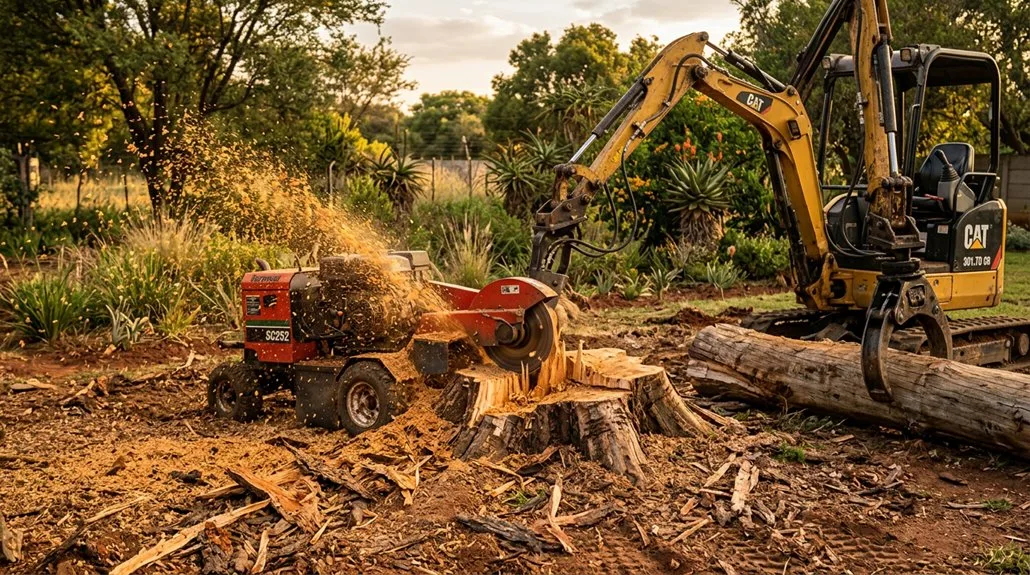
| Grab or thumb | Picks up awkward objects | Logs, stumps, rubble, rocks |
| Destumper | Splits and pulls stumps | Land and plantation clearing |
Ask before you book whether an attachment costs extra, and remember that bucket teeth are wear parts. One rate card we reviewed charges R460 for a single broken tooth and R2,500 for a full set.
Licences, safety and the law
South African law puts real duties on whoever runs the machine and the site:
- Operator competence. The Driven Machinery Regulations, 2015 under the Occupational Health and Safety Act require that people operating driven machinery are trained and competent to do so. Our guide to excavator licence requirements in South Africa explains what that means in practice.
- Excavation safety. Regulation 13 of the Construction Regulations, 2014 requires the contractor to evaluate the stability of the ground before excavation work begins, and to keep excavations safe while people work in and around them.
- Services underground. Get service drawings and have cables and pipes located before anyone digs. A cut fibre or power cable can cost far more than the hire.
- Overhead power lines. Plan the machine’s position so the boom can never swing near a line.
Before you dig: never let anyone stand inside the machine’s swing radius, and never let anyone work in a trench until a competent person has checked that the walls are stable or supported.
Hiring with an experienced operator takes most of this off your plate. They know the machine, the safe working distances and the daily checks. If you do run a machine yourself, our guide to daily checks during hire applies to excavators too.
Your pre-hire checklist
Send these answers with your enquiry and you will get a faster, more accurate quote. Tip: copy the list into WhatsApp and fill it in on site.
- What is the job? (trench, dam, foundations, stumps, loading)
- How deep and how long or wide?
- Roughly how much material moves, and where does it go?
- Where is the site? (a pin location is perfect)
- Narrowest access width and any height limits
- Ground conditions: soft, rocky, wet, paved?
- Any services, septic tanks or power lines nearby?
- With operator or without?
- Who supplies the diesel?
- Start date and how many days you expect
- Do you need tippers, a roller or a water cart as well?
- Who is the contact person on site?
7 expensive excavator hire mistakes (and how to avoid them)
- Hiring too big. You pay more per hour, more for transport and more to repair lawns and paving.
- Hiring too small. A mini excavator on bulk earthworks can take many times longer. Cheap per hour, expensive per job.
- Comparing day rates only. Compare the full cost: transport, diesel, operator, minimum hours and attachments.
- Ignoring the minimum hours. If the machine is billed for 9 hours, plan 9 hours of work.
- Not preparing the site. A machine that waits for gates to be opened or cars to be moved is burning your money.
- Digging blind. Locate underground services first, every time.
- Forgetting where the soil goes. Arrange trucks, spoil areas or backfill before the first bucket.
Excavator hire in Piet Retief, Mkhondo and surrounds

At Bendet we have been hiring out plant from Piet Retief since 2011. Our excavators come with experienced, certified operators and we deliver to site, so you do not have to arrange a lowbed or find someone to run the machine. Around Mkhondo the work is varied: farm dams and contour banks, plantation roads, stump removal after harvesting, foundations, and water and electrical trenches.
We regularly work in Piet Retief, Paulpietersburg, Ermelo, Pongola and northern KwaZulu-Natal. Being local keeps transport costs down, and we can usually tell you within one phone call which machine your job needs. Need more than digging? Our earthmoving services cover site clearing, levelling and soil moving with excavators, TLBs, tippers and rollers.
Get a clear excavator quote in one call. Tell us what you are digging and where, and we will recommend the right machine and give you a rate that shows exactly what is included. Call 076 202 9021, WhatsApp us a photo of the site, or request a quote online. See all our excavator and plant hire services in Piet Retief.
Frequently asked questions
How much does it cost to hire an excavator per hour in South Africa?
On published South African rate cards, a mini excavator costs about R160 an hour and a 20 to 30-ton excavator roughly R485 to R540 an hour, excluding VAT and diesel. Most suppliers charge a minimum of 8.5 to 9 hours per day, so the hourly rate is mainly useful for comparing quotes.
How much is an excavator per day?
Expect about R1,440 to R1,600 a day for a mini excavator and about R4,200 to R4,900 a day for a 20 to 30-ton machine on a dry rate. Transport to site, diesel and an operator (if not included) come on top, and can add more than half again to the total.
What size excavator do I need for a farm dam or bulk earthworks?
A 20 to 22-ton excavator is the usual choice for farm dams, roads and bulk earthworks. It digs about 6.6 m deep, loads tippers efficiently and is big enough to work all day without overloading. Bigger jobs in rock may need a 30-ton machine with a breaker.
Will a mini excavator fit through my gate?
Often, yes. A Cat 302 CR mini excavator has a track width of 1,090 mm with the tracks retracted, so it fits through many standard garden gates. Measure your narrowest gap and any height limits and tell your supplier before you book.
Do I need a licence to operate an excavator?
The Driven Machinery Regulations, 2015 require operators of driven machinery to be trained and competent. In practice that means a recognised operator training certificate and a medical certificate of fitness on most sites. Hiring with an operator avoids the question altogether.
What is the difference between wet hire and dry hire?
Wet hire includes the machine, an operator and diesel in one rate. Dry hire usually excludes diesel and sometimes the operator. Because suppliers use the terms differently, always ask exactly what a quote includes.
Is there a minimum hire period?
Most suppliers bill at least one full day of 8.5 to 9 hours, even if the machine works less. Longer bookings usually lower the daily rate and spread the transport cost over more days.
Do you deliver excavators around Piet Retief?
Yes. Bendet delivers excavators with experienced operators to sites in Piet Retief, Mkhondo, Paulpietersburg, Ermelo, Pongola and northern KwaZulu-Natal. Call 076 202 9021 for a quote.
More excavator and plant hire guides
- Excavator hire rates per day in South Africa
- Excavator rental costs: fuel, transport and extras
- 20-ton vs 30-ton excavator: specs, fuel use and rates
- Mini excavator hire: is it right for your project?
- Do you need a licence to operate an excavator?
- TLB hire guide: what a backhoe loader can do
- Stump grinding and stump grinder hire: the complete guide